

A mobile onboarding journey for business banking customers in the UAE that replaced in-branch identity verification with Emirates Face Recognition, so a business account could be opened end to end without a branch visit.
Date
2023 - 2024
Role
Sole product designer — end to end
Platform
Mobile App
My role — I was the only designer on this project and owned it end to end: discovery and research, information architecture, interaction and interface design, prototyping, usability testing, and design QA through to release. I worked directly with Product, Engineering, Compliance and Risk, and the Business teams, and made the design decisions across the journey.
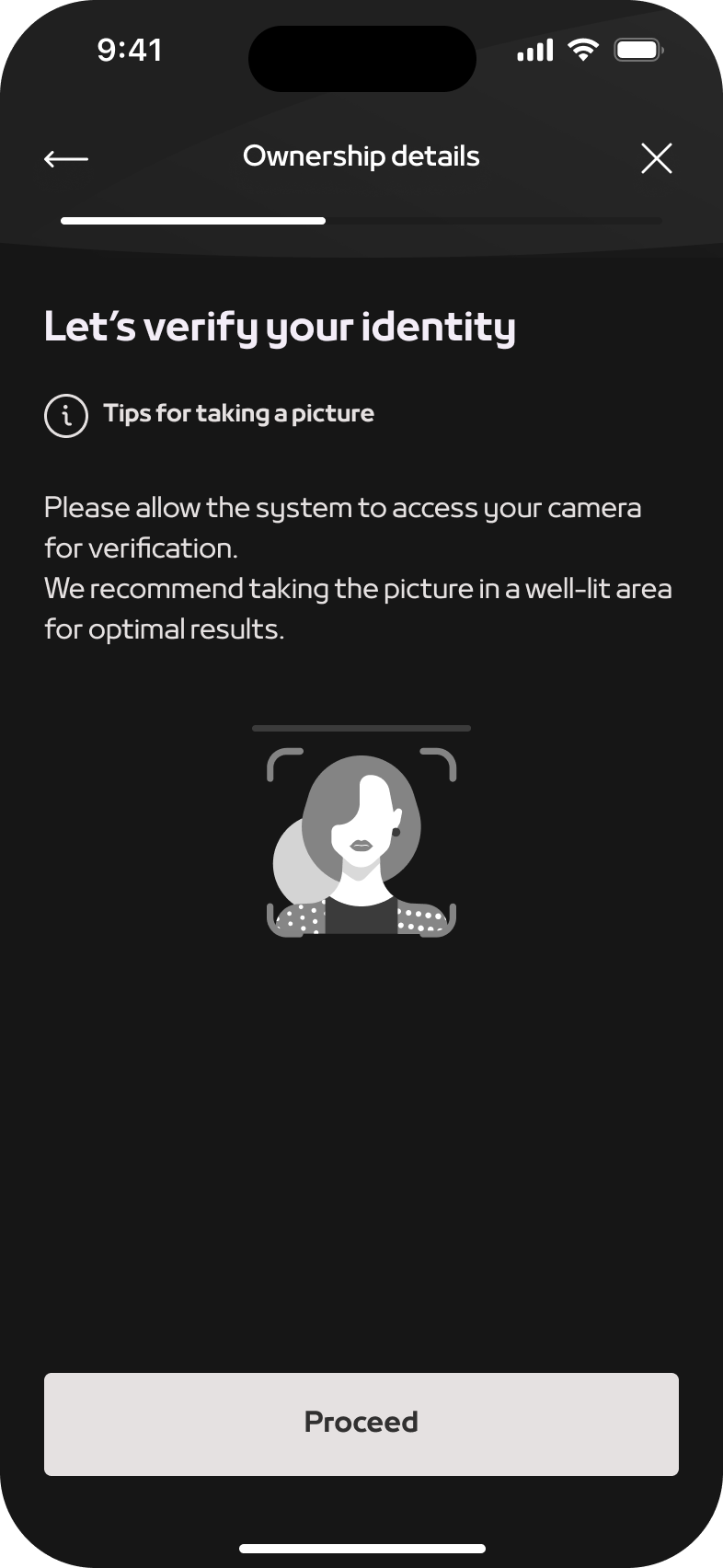
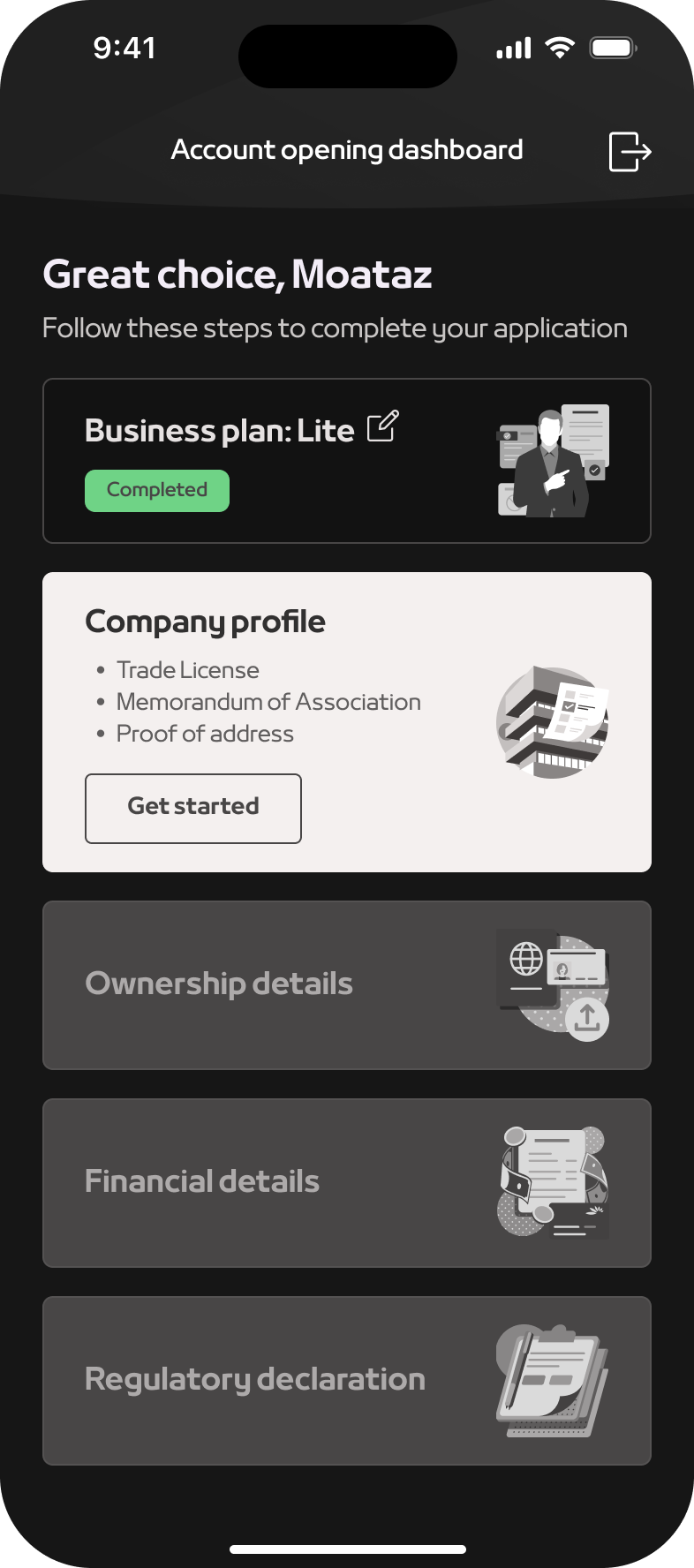
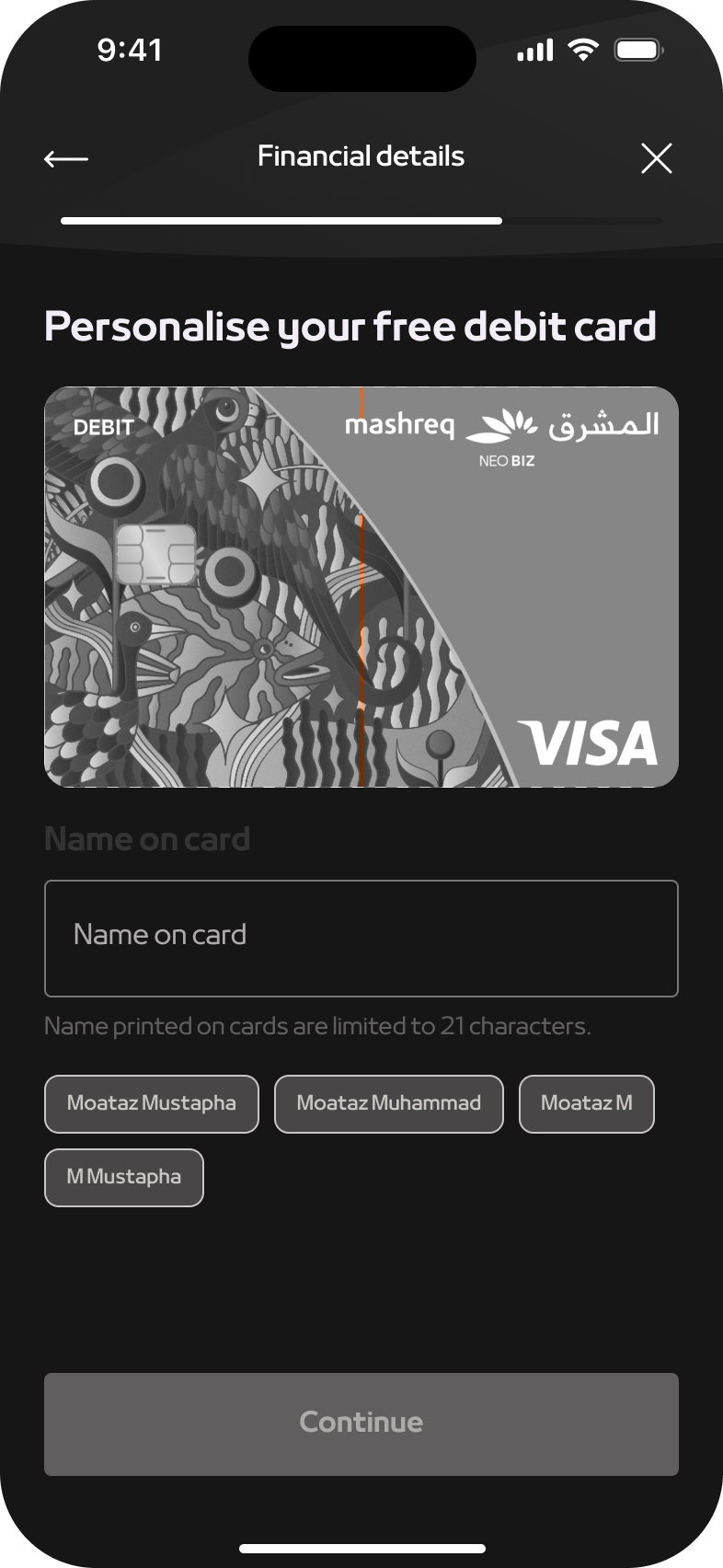
Create a seamless and efficient mobile onboarding process for business banking customers in the UAE to significantly enhance user experience and increase customer acquisition.
Enhance User Experience
Achieve a user satisfaction score of at least 85% in post-onboarding surveys. Reduce the average onboarding time so the process can be completed within 10 minutes.
Increase Customer Acquisition
Increase the conversion rate of potential customers to active users by 30% within the first six months after implementing the new onboarding process.
Grow the number of new business banking customers by 25% quarter-over-quarter for the first year.
Develop a Mobile App
Launch a fully functional mobile app with the new onboarding process within six months.
Achieve a minimum of 10,000 downloads in the first three months post-launch, with at least 70% of users completing the onboarding process.
The existing onboarding process for business banking customers in the UAE is cumbersome and inefficient. Users face multiple hurdles, such as complicated forms, lack of clear guidance, and lengthy verification processes, leading to a high drop-off rate during onboarding.
Business banking customers require a streamlined, intuitive onboarding process that minimizes time and effort. They seek clear instructions, secure data handling, and the ability to complete the process with ease, preferably from a mobile device.
I ran discovery myself: surveys, in-depth interviews with business banking customers, and usability testing sessions. I chose a mix of qualitative and quantitative methods so behavioural patterns could be measured and the reasons behind them understood.
The research revealed several critical pain points: users found the existing onboarding forms too lengthy and confusing, security concerns were prominent, and there was a significant need for real-time assistance during the process. Users also preferred a mobile-first approach for convenience.
I benchmarked the onboarding journeys of leading competitors and mapped where ours fell behind. Competitors with shorter, clearer flows showed higher satisfaction and lower abandonment, which set the bar this journey had to beat.
From the research findings I built detailed personas covering goals, pain points, and typical behaviours, and used them to keep design decisions anchored to real customer segments rather than assumptions.
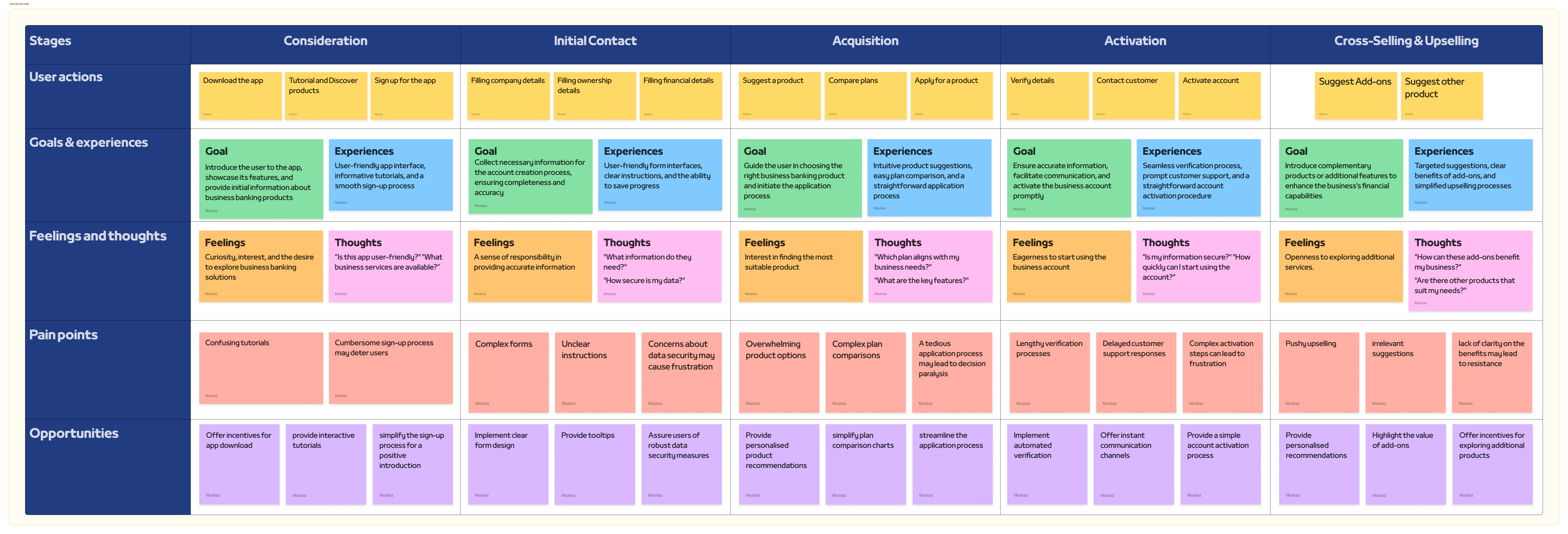
I mapped the end-to-end onboarding journey to see every step a customer takes. That surfaced the critical touchpoints and the specific stages where people were dropping out.
I ran ideation sessions with Product, Engineering, and Compliance to pressure-test concepts against the pain points from research — and against what was actually buildable and permitted under regulation.
I sketched the flow at low fidelity first to get the sequence right before committing to interface design, then used the wireframes to walk Product and the business through the order of steps before any interface work started.
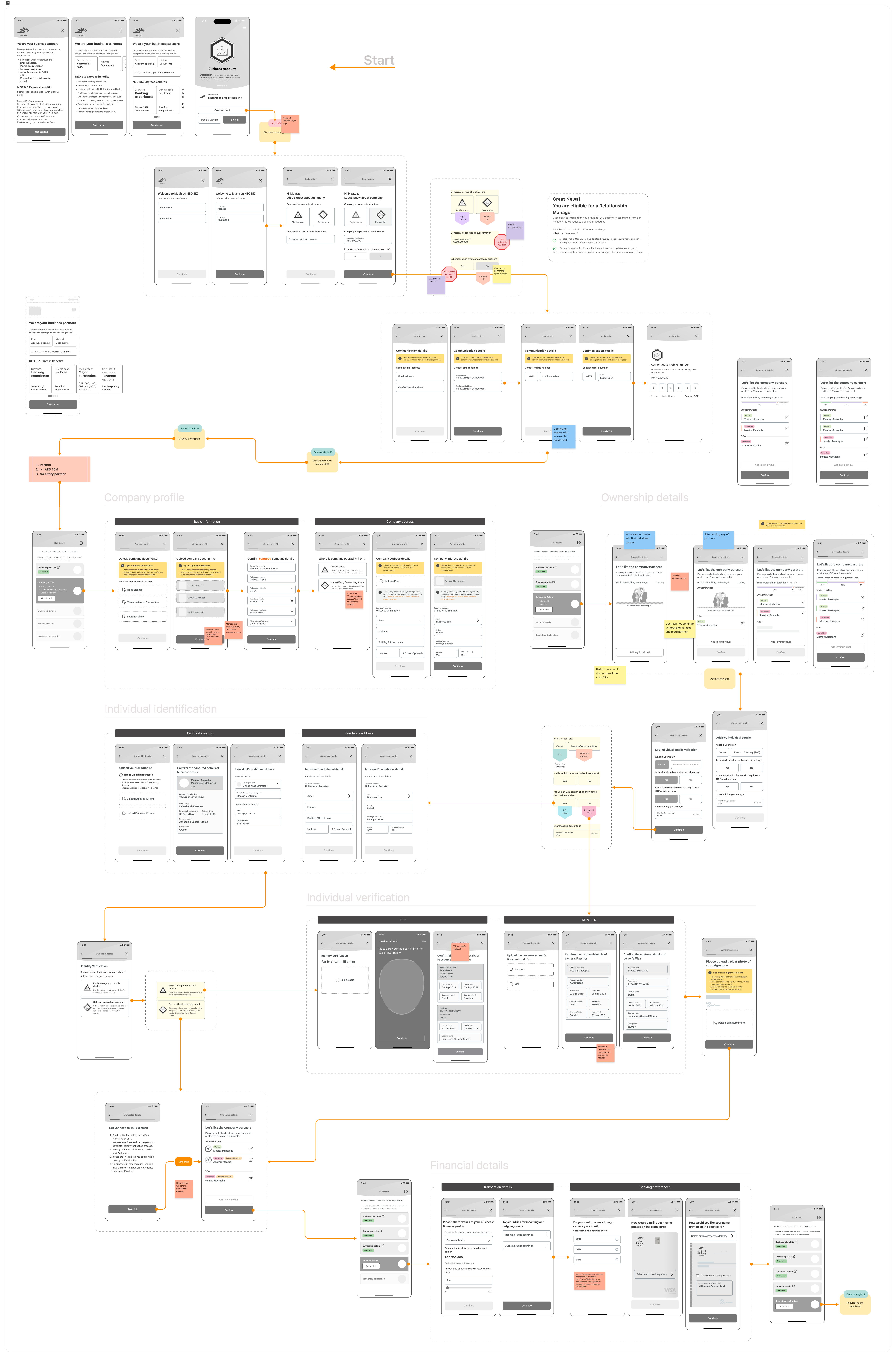
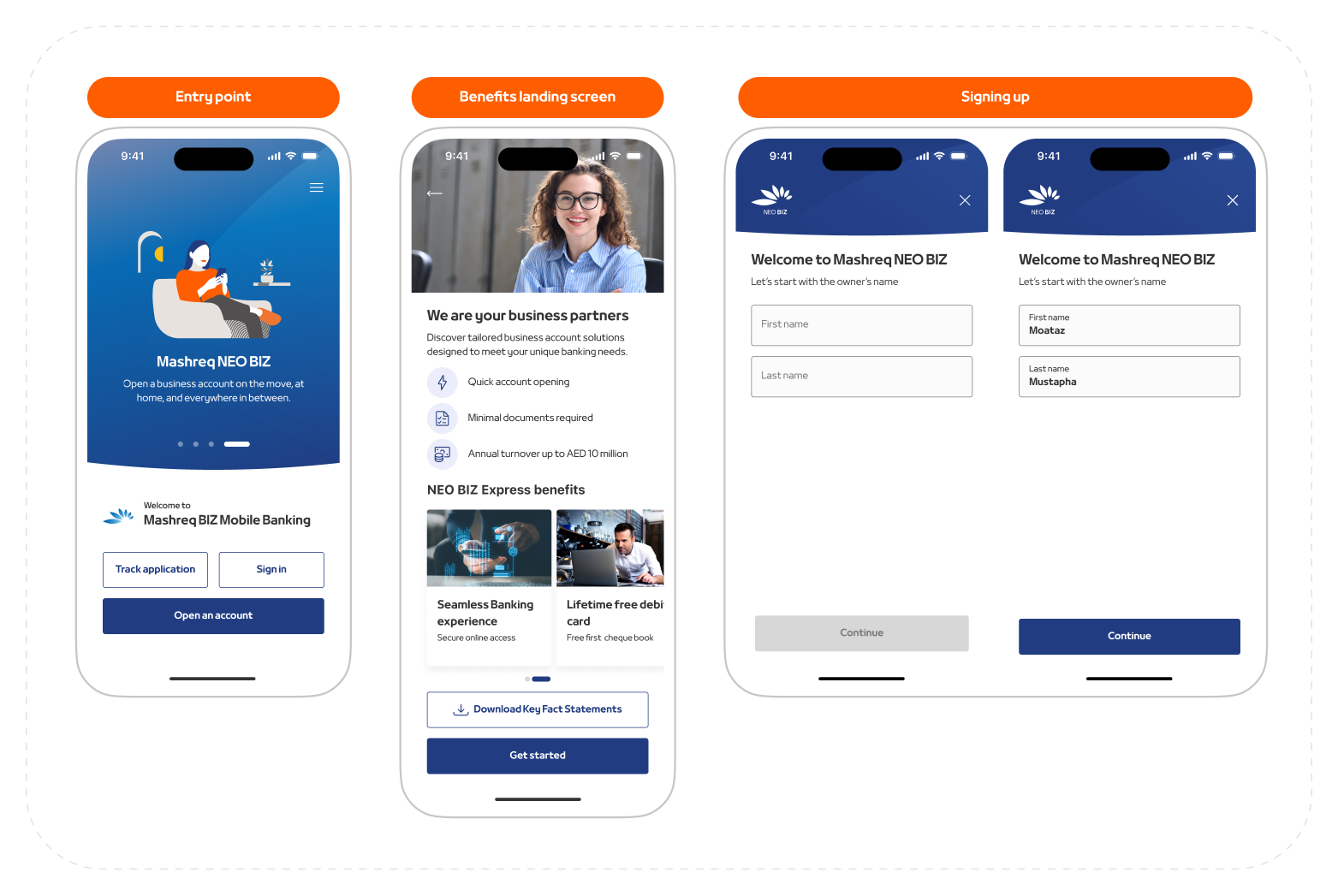
The journey opens with company data, then the details of each customer on the account, and only then identity verification through Emirates Face Recognition, run separately for every customer. I sequenced it that way deliberately: asking a business owner to submit their face before the app has shown any understanding of their company reads as intrusive, and it is also the most abandonment-prone step to place first. By the time verification arrives, the customer has already invested effort and can see what it is for. Where face recognition cannot complete, the customer uploads passport and visa instead, so a failed check narrows the path rather than ending it.
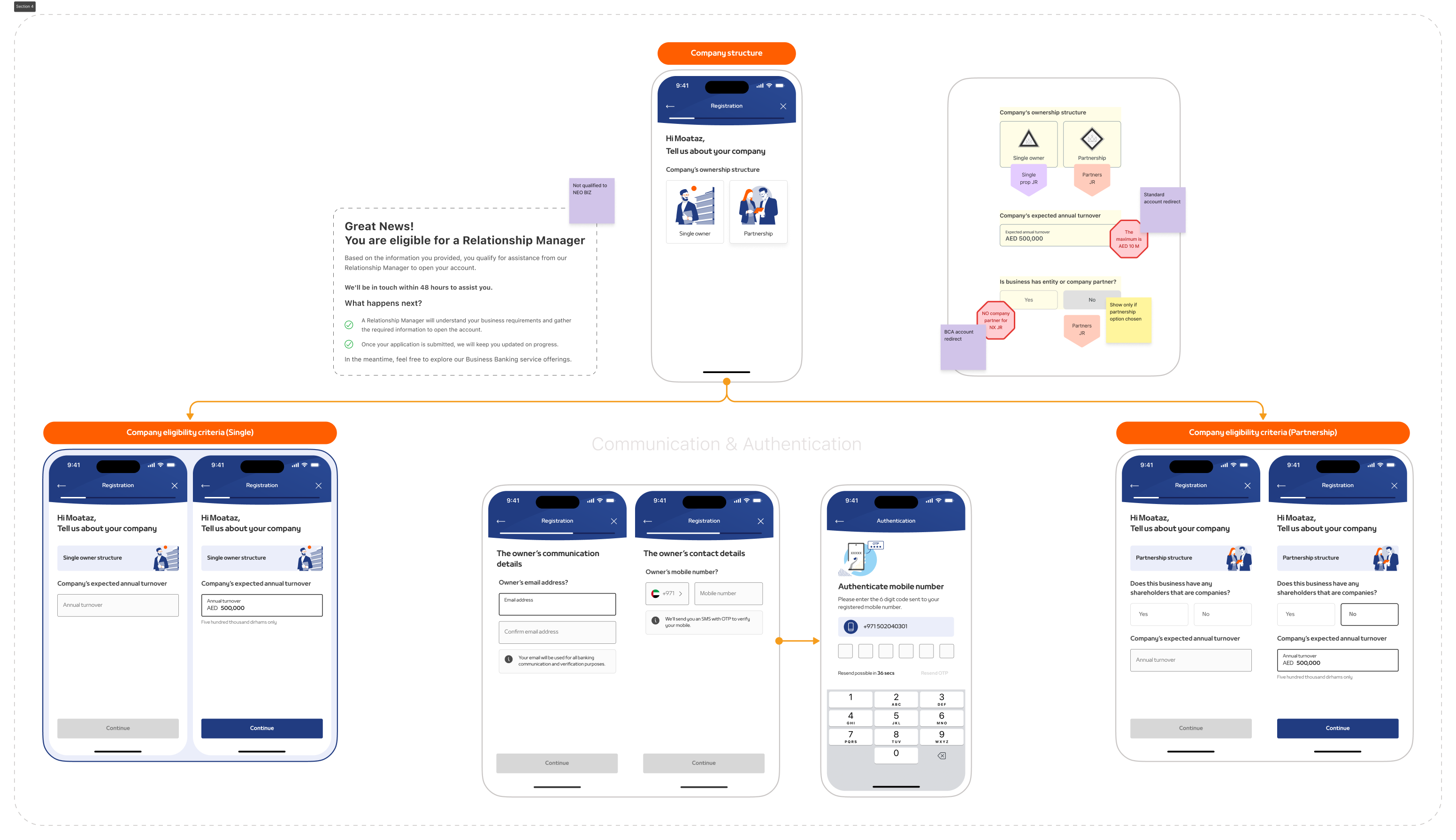
I broke the journey into distinct steps rather than one long form. A single form is faster to build and shorter on paper, but it hides how much is left and gives no natural place to save progress. Splitting it made the remaining work visible at every point, which mattered more here than raw speed — business onboarding requires documents people often do not have to hand on the first attempt.

Users capture required documents through the device camera or file upload. I designed the capture step to validate the document at the point of upload, so a rejected file surfaces immediately instead of after submission.
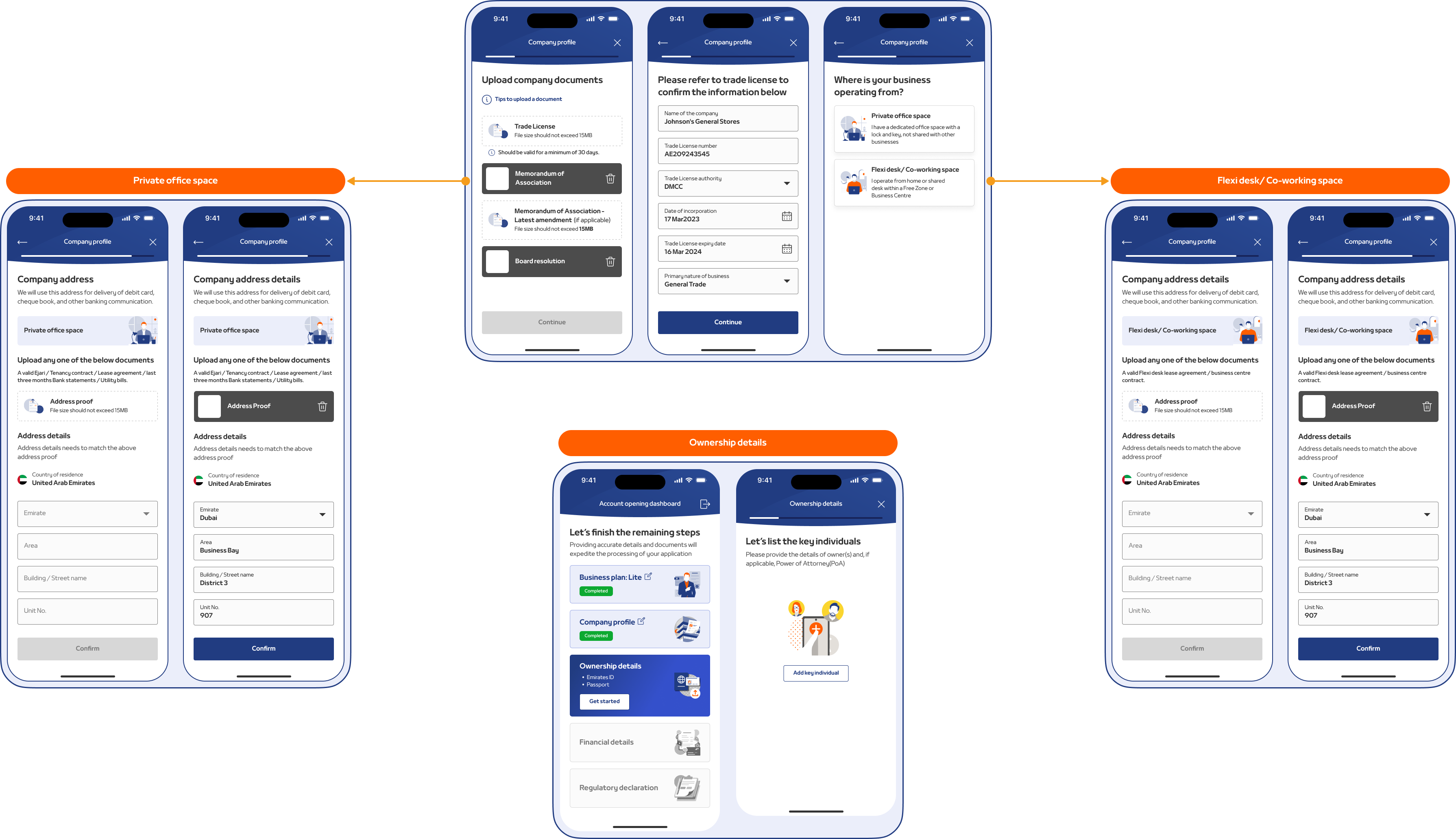
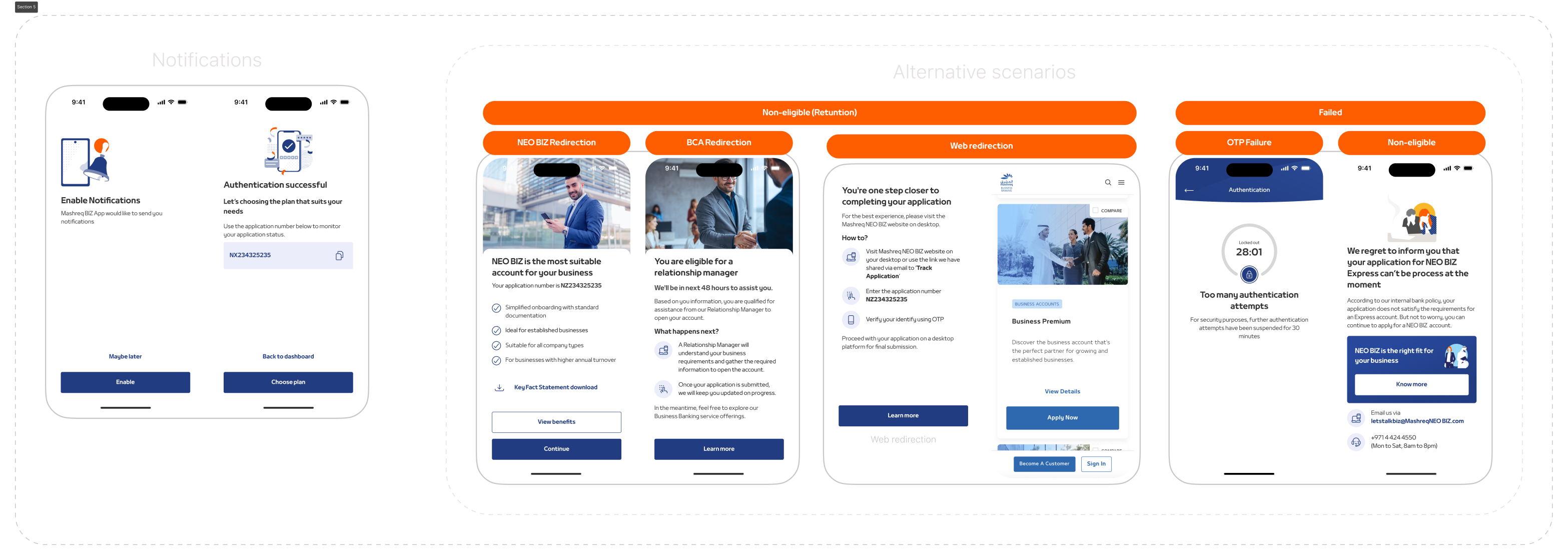
Business onboarding involves back-office checks the customer cannot see. Status updates at each stage were the design response to that gap, so the customer always knows where the application stands.
I tested the prototype with real users, using think-aloud protocols, task completion rates, and post-test interviews to see where the design held up and where it did not.
Feedback from usability testing highlighted areas for improvement, such as simplifying certain form fields and enhancing visual cues for better navigation. Users appreciated the clear instructions and secure authentication measures.
I refined the design against what testing showed: simplifying form fields, strengthening the visual cues for navigation, and reworking the steps where users hesitated.
The journey replaced a branch-dependent process with one a business owner can complete on a phone. Opening a business account previously took between two working days and a full week; through this journey it completes in around ten minutes. Removing the branch visit also removes the single largest source of drop-out in business onboarding, and moves verification effort from staff time to infrastructure. Wider post-launch measurement is owned by the business unit, so the remaining figures on this page are stated as targets rather than as results.
For the customer, the change is concrete: no branch appointment, no paper file, and identity verified from the phone in the same sitting. Usability testing showed the two things that decide whether someone finishes are knowing what is still required of them, and being able to stop and resume without losing what they entered. Both drove the final structure.
The secure authentication measures ensured the safety of their personal and business information, enhancing their trust in the bank. The ability to upload documents directly through the app and receive real-time updates on their application status added convenience and transparency to the process.
Overall, the improved onboarding experience led to higher satisfaction levels among customers, fostering loyalty and encouraging them to recommend the bank’s services to others.
The constraint that shaped this project was regulatory, not visual. Business onboarding carries KYC obligations that cannot be designed away, so the work was not about removing steps but about sequencing them so that the hardest one arrives when the customer is most willing to complete it. What I would do differently: the measurement plan should have been agreed with the business before launch rather than after, so that the design decisions and the outcome data belonged to the same conversation.